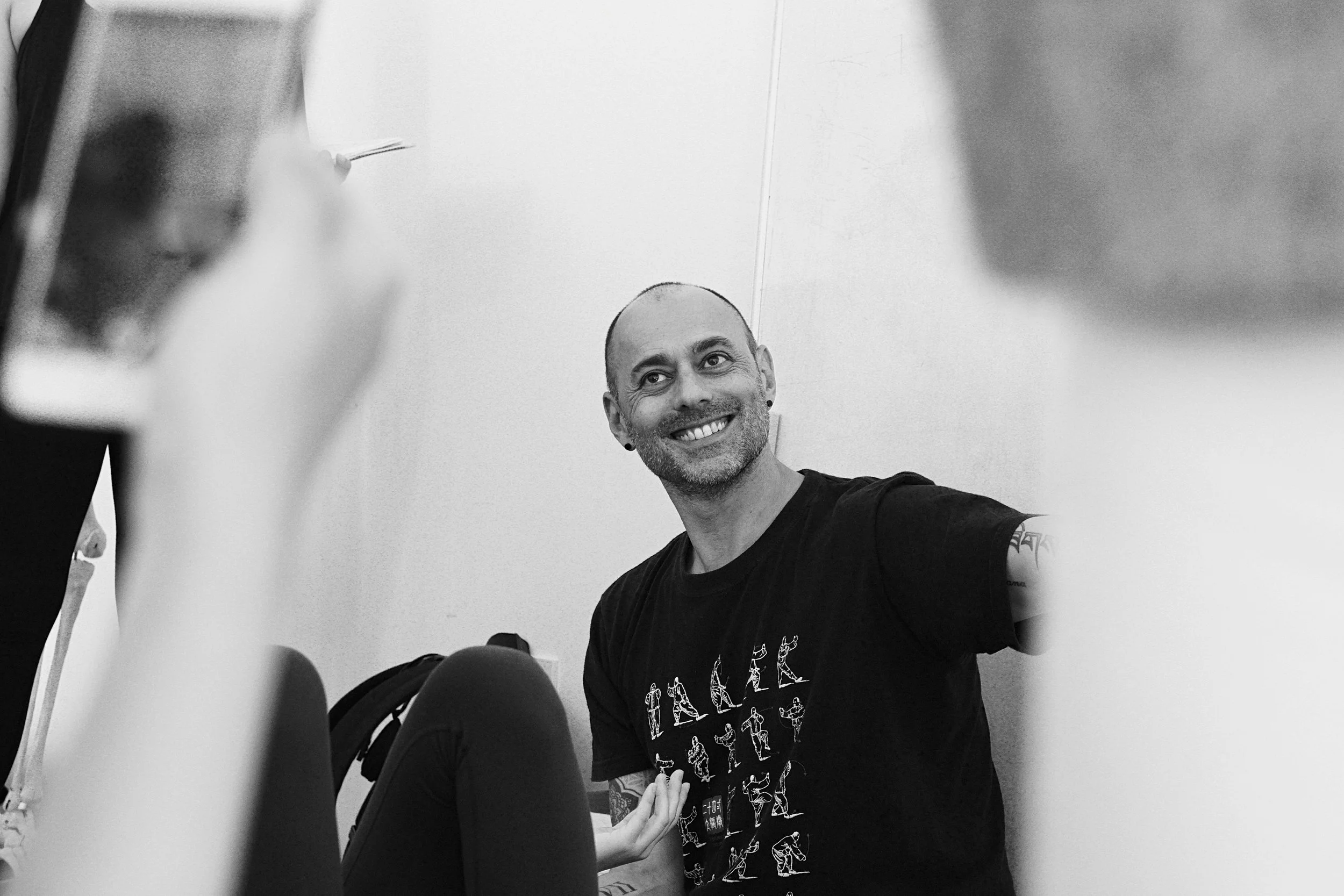
Vincent Bolletta
I am a visual artist and somatic movement therapist based in Dunedin, New Zealand. For over three decades, my work has been dedicated to understanding the structural integrity and high-dimensional geometry of the human experience. Through my background in biomechanics, yoga, and Tai Chi, I have learned that the physical body is not a static object, but a dynamic, shifting container of immense internal forces. I approach the canvas through this exact same somatic lens.
My work exists at the intersection of structural geometry and psychological inquiry. I do not aim to paint a passive subject or a superficial likeness; rather, I build visceral, tactile environments that map our internal landscapes. I utilize heavy, tectonic layers of impasto paint that act much like shifting plates—representing the continuous, interdependent accumulation of our behaviors, histories, and personal biases.
My creative process is an act of continuous sensing and evaluation. I allow intuition and the raw, chaotic energy of the medium to guide the composition, but I firmly believe in the necessity of a structural relationship that brings order to the abstraction. Whether I am exploring the fractured, repaired beauty in Kintsugi, the collective accumulation of identity in Beijia Bei, or the psychological boundaries in The Look of the Unimpressed, I rely on deliberate structural lines to connect and manage fragmented elements. These lines are the vital seams that hold our complex realities together.
I am deeply influenced by the raw edge of Basquiat, the structural minimalism of Mondrian, and the quiet, continuous flow of Taoist principles. In my figurative pieces, I often dissolve the traditional boundaries of flesh, transforming the human silhouette into a contained explosion of color and chaotic texture. This juxtaposes the manufactured realities we present to the external world against the vibrating, complex vitality just beneath our skin.
Ultimately, my art is a therapeutic tool—a visual extension of the perception-action cycle. By translating the mechanics of tension, release, and resilience onto the canvas, my goal is to create a grounded space for the observer. I invite the viewer to step into these heavily layered topographies, confront the tension of their own manufactured realities, and discover the profound beauty in the balance of their own internal order and chaos..
Kintsugi
In his latest work, Kintsugi, contemporary artist Vincent Bolletta translates the ancient Japanese philosophy of repairing broken pottery into a breathtaking, large-scale tectonic abstraction. This is not just a painting to be viewed; it is an environment to be felt.
Built with fiercely textured, heavy impasto layers, Kintsugi mirrors the shifting tectonic plates of the human experience. Where the composition fractures, deliberate, black lines mend the breaks—transforming chaos into a profound structural order.
Drawing from his deep background in somatic movement and physical therapeutics, Bolletta brings a visceral understanding of tension, release, and resilience to the canvas. The result is a raw, psychological landscape that reminds us of a universal truth: our scars are not flaws to be hidden, but the very gold that holds us together.
Mute
A Photographic Exhibition by Vincent Bolletta & Jac Wilson
When the voice is stripped away, the body speaks in tectonic shifts.
Mute is a visual exploration of the raw, unfiltered dialogue between flesh, gravity, and space. Born from the intersection of visual artist and somatic movement therapist Vincent Bolletta and the visceral, avant-garde performance art of Jac Wilson, this collection dismantles the boundaries of traditional movement photography.
Here, Bolletta’s profound understanding of human biomechanics and the perception-action cycle collides with Wilson’s kinetic rebellion. Known as a "punk ballerina" whose physical expressions defy classical constraints, Wilson provides a fiercely kinetic canvas. Through Bolletta's lens, the camera captures not just the aesthetic of the pose, but the internal architecture of the movement—the psychological weight, the muscular tension, and the high-dimensional geometry of a body in transition.
The title is a provocation. Mute forces a sensory shift, demanding that the viewer listen entirely with their eyes. It strips away the auditory context of performance to reveal the naked mechanics of expression. These are not pristine, choreographed moments; they are suspended breaths of tension, release, and deeply human vulnerability.
Cherry Blossom
T H E S O M A T I C C O N T A I N E R S
A Figurative Series by Vincent Bolletta
In this striking series of paintings, Vincent Bolletta merges his signature tectonic abstraction with the human figure. Moving away from traditional portraiture, these works do not attempt to capture the external, recognizable likeness of a subject. Instead, they operate as psychological and somatic maps—visualizing the raw, high-dimensional energy of the internal self.
The defining visual mechanic of this series is the profound contrast between boundary and interior. Each figure is anchored by a bold, unyielding contour line—a rigid structural container that asserts the physical form's presence in space. Yet, within these heavy black boundaries, traditional flesh is entirely dissolved. The interior of the body explodes into a dense, vibrating mosaic of heavy impasto color and chaotic texture.
This juxtaposition visually articulates a core physical reality: the human frame acts as a structured vessel holding immense, shifting internal forces. The paintings capture the tension between the boundaries we present to the external world and the complex, chaotic vitality vibrating just beneath the skin.
Bolletta isolates these figures against fiercely textured, atmospheric backgrounds. Built with thick, shifting strokes of paint, these environments do not recede quietly; they press against the subjects, emphasizing the tactile weight and gravity of the space they occupy. Because the figures are frequently turned away or remain faceless, individual identity is stripped away. The subject becomes a universal representation of the human condition, navigating the heavy architecture of their environment.
Deeply informed by an understanding of structural integrity, tension, and release, this series is a visceral exploration of internal vitality. By transforming the human silhouette into a contained explosion of color and texture, Bolletta invites the viewer to look past the surface of the physical body and witness the deeply rooted, vibrating architecture of the human experience..
Eastern Lights
In Eastern Lights, Vincent Bolletta presents a profound exploration of perception, movement, and internal topography. Drawing heavily upon decades of somatic inquiry and the kinetic philosophies of Eastern movement disciplines, this series transcends standard visual abstraction. Here, light is not treated merely as a photon striking a surface, but as a dynamic, living force—a visual translation of biomechanical flow and the subtle, continuous exchange between the body and its environment.
The collection reflects a unique synthesis of geography and high-dimensional geometry, bridging the grounded stillness of Aotearoa with the vital, pulsing energies encountered across Asia. Bolletta’s signature tectonic approach to art-making remains a vital undercurrent throughout the series. Even as the work attempts to capture the ephemeral and the luminous, it is anchored by a deep, tactile psychological weight. The compositions suggest a complex state space where memory, breath, and the perception-action cycle collapse into singular, resonant moments.
Ultimately, Eastern Lights asks the viewer to engage with the work not just optically, but physically. It is an invitation to experience the concept of 鬆 (song)—a yielding, active relaxation—translated directly into visual form. Through these intricate topographies of energy and shadow, the series captures the enduring, rhythmic hum of human consciousness in motion, offering a space for both quiet introspection and powerful kinetic release.
Series A
Vincent Bolletta & Marc Mateo
In Series A, the tranquil sanctuaries traditionally associated with somatic practice are entirely abandoned. In their place is the raw, unyielding theater of the modern metropolis. This collaborative photographic exhibition captures a profound physical and visual dialogue between the organic architecture of the human body and the rigid geometry of concrete, glass, and steel.
The collection represents a rare intersection of two distinct masteries. Somatic movement therapist Vincent Bolletta approaches the urban environment not as a backdrop, but as a structural partner. Drawing upon decades of work in biomechanics, postural re-patterning, and functional movement, Bolletta’s presence in these frames defies the concept of the performative "pose." Instead, the viewer witnesses a live perception-action cycle—a body dynamically negotiating gravity, tension, and spatial awareness against harsh, manufactured surfaces. The flesh yields, adapts, and asserts its own high-dimensional geometry in spaces designed for machines and masses, not the solitary human form.
Complementing this physical mastery is the lens of the late New Zealand cinematographer and photographer, Marc Mateo. Renowned for his exceptional command of light and shadow, Mateo bathes the gritty cityscape in a moody, cinematic brilliance. He does not merely document Bolletta’s movement; he sculpts the urban landscape around it. Through Mateo’s chiaroscuro lighting, alleyways, stairwells, and concrete expanses are transformed into dramatic, isolated stages, amplifying the tension and isolation of the lone figure within the city.
Previously exhibited across New Zealand and the United States, and featured internationally in Yoga Journal Russia, Series A remains a striking testament to embodied art. It asks the viewer to consider how we maintain our structural and psychological center within a world of hard lines. It is an exploration of resilience, the beauty of functional adaptation, and the enduring legacy of two artists meeting at the height of their respective crafts.
Beijia Bei (百家被)
In Beijia Bei (百家被), Vincent Bolletta translates the traditional Chinese "Hundred Families Quilt" into a visceral landscape of heavy, tectonic abstraction. The original cultural practice—stitching together fragmented fabric scraps from various neighbors and families to form a protective, unified blanket for a child—serves as the conceptual foundation for this series of deeply psychological portraits and abstract compositions.
Bolletta constructs these canvases not through delicate brushwork, but through thick, shifting layers of impasto. The paint behaves like tectonic plates, pressing, overlapping, and colliding to form a highly textured topography. This structural approach to the medium mirrors the physical reality of the patchwork quilt: disparate, fractured elements and histories forcibly brought together to create a complex, interdependent surface. The canvas becomes a tangible record of accumulation, where the seams between the heavy layers are just as important as the layers themselves.
The series transcends pure visual abstraction by integrating Bolletta’s deep understanding of somatic movement, biomechanics, and the perception-action cycle. Each piece operates as a psychological portrait—a map of how internal states and external histories weave together in the human experience.
The heavily layered, high-dimensional geometry of the canvases echoes the architecture of the human body, where memories, physical forces, and adaptive behaviors accumulate over time. Just as the Tai Chi principle of song (鬆) requires an active, conscious release of tension to find structural integrity, the fragmented layers in Beijia Bei yield to one another, finding balance in their structural relationships.
Beijia Bei asks the viewer to examine the seams of their own history. It is a striking exploration of how the fractured pieces of our psychological and physical lives are continuously stitched together. Just as the traditional hundred families quilt offers warmth through its collective patches, Bolletta’s tectonic canvases offer a therapeutic visual integration of the fragmented self, forming a resilient, unified architecture out of chaos.
The Look of the Unimpressed
In exhibition The Look of the Unimpressed, Vincent Bolletta explores the psychological weight of detachment as an act of profound structural resistance. Moving away from expressions of performative engagement or open vulnerability, this series of psychological portraits captures the dense, unyielding boundary of the unimpressed gaze.
Within these canvases, the refusal to react is not portrayed as an absence of emotion, but as a heavily constructed psychological shield. Using his signature tectonic impasto, Bolletta builds the faces of his subjects through thick, accumulating layers of paint. The highly textured topography of the canvas gives the subjects an immense physical and emotional gravity. Their expressions do not yield to the viewer; instead, the heavy, shifting layers of the composition reinforce a sense of impenetrable stillness.
The exhibition draws a direct line between physical geometry and emotional boundaries. In somatic practice, holding one's center requires a dynamic internal equilibrium—a groundedness that resists being pulled off-axis by external forces. The subjects in The Look of the Unimpressed visually manifest this principle. Their expressions are a form of psychological containment. By remaining unmoved and un-seduced by the external world, they maintain total ownership of their internal architecture.
The exhibition forces a reversal of the traditional gallery dynamic. The portraits do not invite the observer in; they observe the observer with absolute neutrality. Bolletta challenges the viewer to confront this unyielding gaze, transforming the act of looking into a reflection on our own constant need for reaction, validation, and external stimulation. The Look of the Unimpressed is a masterful, tactile study in the power of holding one's ground.
Photographic Collection
This collection explores the interplay between profound intimacy and sweeping, tectonic scale. The high-contrast, monochromatic portraits function as raw psychological studies, capturing the weathered textures of lived experience alongside the stark, ethereal innocence of youth. These deeply personal faces are juxtaposed against the overwhelming vastness of the outside world—from the moody, atmospheric peaks of dramatic southern landscapes to the sprawling, kinetic anonymity of a crowded transit terminal. Bound together by a striking use of light, shadow, and structural form, the gallery serves as a quiet meditation on time, human connection, and our place within both natural and constructed environments.